
| Availability: | |
|---|---|

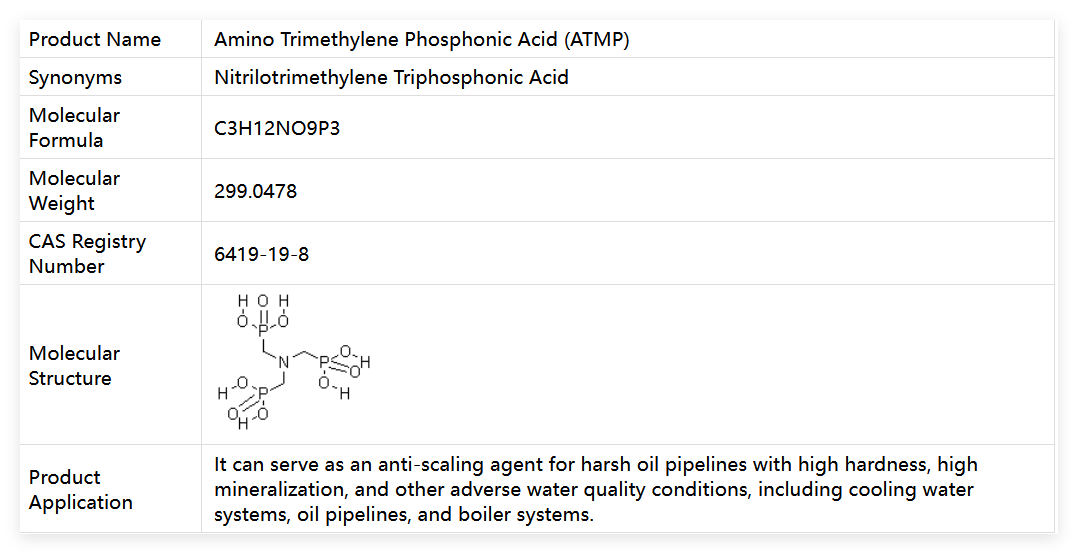
Aminotrimethylene Phosphonic Acid (CAS No.: 6419-19-8), also known as Nitrilotrimethylenephosphonic Acid or Aminotrimethylenephosphonic Acid, is an organophosphorus water treatment agent with both high-efficiency scale inhibition and corrosion inhibition properties. Its molecular formula is C₃H₁₂NO₉P₃, and its molecular weight is 299.05. The product has flexible appearance forms, which can be colorless or light yellow transparent liquid, or white granular crystalline solid. Both forms have good solubility—it is easily soluble in water, ethanol and acetone, and will not separate even when boiled together with sulfuric acid, making it suitable for various industrial application scenarios.
In terms of core physicochemical properties, its density is 2.1±0.1 g/cm³ under normal conditions (1.3-1.4 g/mL for liquid form at 25℃); its melting point is approximately 215℃ (with decomposition), and the decomposition temperature of dry products ranges from 200℃ to 212℃, showing excellent thermal stability. Its boiling point reaches 746.2℃ (under 760 mmHg), and flash point is 405.1℃, so there is no need to worry about flammability risks during use. In addition, the product has stable chemical properties, is not easy to hydrolyze, and can still maintain excellent performance even in high-temperature environments of 200℃. At the same time, it has strong complexing ability and can form stable complexes with metal ions such as calcium and magnesium, laying a foundation for subsequent scale inhibition and corrosion inhibition effects.
Through the triple synergistic mechanism of "chelation + threshold inhibition + lattice distortion", it can fundamentally prevent the formation and deposition of scaling salts (especially calcium carbonate scale) in water. Even in harsh water quality with high hardness and high mineralization, it can maintain stable scale inhibition effect, solving the pain point of "efficacy attenuation in complex water quality" of traditional agents.
It breaks through the temperature limit of conventional water treatment agents, remains effective even at 200℃, and can be directly applied to high-temperature scenarios such as boilers and high-temperature circulating cooling water. At the same time, it has stable chemical properties, is not easy to hydrolyze, and will not undergo performance degradation during long-term storage or use, effectively ensuring the consistency of treatment effects.
It has extremely low toxicity to organisms—the LD₅₀ of 50% aqueous solution for oral administration in rats reaches 7300 mg/kg, meeting the "practically non-toxic" standard. It is only slightly toxic to fish (96h-LC₅₀ = 150 mg/L for Atlantic salmon) and aquatic invertebrates (48h-EC₅₀ = 297 mg/L for Daphnia magna). After use, it will not burden the water environment, conforming to the modern industrial demand of "balancing environmental protection and efficiency".
Compared with ordinary organophosphorus agents, this product can not only cope with conventional cooling water systems, but also adapt to harsh scenarios such as oil pipelines and oilfield reinjection water with high hardness and high mineralization. There is no need to frequently adjust the type of agent due to changes in water quality, reducing the process adaptation cost of enterprises.
It can be freely compounded with other organophosphoric acids, polycarboxylic acids or salts to form organic alkaline water treatment agents with stronger targeting, adapting to circulating cooling water systems in different industries. The dosage is precise—only 1-20 mg/L is required for scale inhibition scenarios, and 20-60 mg/L for corrosion inhibition scenarios to meet the standard. Compared with traditional agents, the dosage is reduced by more than 30%, significantly lowering the use cost of enterprises.
It integrates the functions of "scale inhibition, corrosion inhibition and metal ion chelation". In water treatment systems, it can replace the combined scheme of "single scale inhibitor + separate corrosion inhibitor", simplifying the agent addition process. At the same time, it can be used as a chelating agent or surface treatment agent in the fields of textile printing and dyeing and metal surface treatment, realizing "one agent for multiple scenarios" and reducing the types of agents purchased by enterprises.
- Circulating cooling water systems in thermal power plants and oil refineries: By inhibiting scale deposition and corrosion of metal pipelines, it extends the service life of heat exchangers and pipelines, reduces the reduction of thermal efficiency caused by scaling, and lowers the frequency of shutdown for cleaning.
- Boilers and oil pipelines: For water quality with high hardness, it effectively prevents scale formation in boilers (avoiding safety hazards caused by local overheating), and at the same time reduces blockage and corrosion of oil pipelines due to scaling, ensuring transportation efficiency.
It is used in oilfield reinjection water systems to solve the corrosion and scaling problems of metal wellbore and water transmission pipelines during reinjection. It avoids the impact of oil layer blockage or equipment corrosion caused by scaling on mining progress, and adapts to the special needs of oilfield reinjection water with high mineralization.
- Textile printing and dyeing: As a metal ion chelating agent, it effectively complexes metal ions in water, preventing them from reacting with dyes to cause uneven color and fabric embrittlement, and improving the quality stability of printed and dyed products.
- Metal surface treatment: As a surface treatment agent, it forms a protective film on the metal surface, enhances the corrosion resistance of metals, and is suitable for the pretreatment of metal products such as auto parts and mechanical accessories.

Aminotrimethylene Phosphonic Acid (CAS No.: 6419-19-8), also known as Nitrilotrimethylenephosphonic Acid or Aminotrimethylenephosphonic Acid, is an organophosphorus water treatment agent with both high-efficiency scale inhibition and corrosion inhibition properties. Its molecular formula is C₃H₁₂NO₉P₃, and its molecular weight is 299.05. The product has flexible appearance forms, which can be colorless or light yellow transparent liquid, or white granular crystalline solid. Both forms have good solubility—it is easily soluble in water, ethanol and acetone, and will not separate even when boiled together with sulfuric acid, making it suitable for various industrial application scenarios.
In terms of core physicochemical properties, its density is 2.1±0.1 g/cm³ under normal conditions (1.3-1.4 g/mL for liquid form at 25℃); its melting point is approximately 215℃ (with decomposition), and the decomposition temperature of dry products ranges from 200℃ to 212℃, showing excellent thermal stability. Its boiling point reaches 746.2℃ (under 760 mmHg), and flash point is 405.1℃, so there is no need to worry about flammability risks during use. In addition, the product has stable chemical properties, is not easy to hydrolyze, and can still maintain excellent performance even in high-temperature environments of 200℃. At the same time, it has strong complexing ability and can form stable complexes with metal ions such as calcium and magnesium, laying a foundation for subsequent scale inhibition and corrosion inhibition effects.
Through the triple synergistic mechanism of "chelation + threshold inhibition + lattice distortion", it can fundamentally prevent the formation and deposition of scaling salts (especially calcium carbonate scale) in water. Even in harsh water quality with high hardness and high mineralization, it can maintain stable scale inhibition effect, solving the pain point of "efficacy attenuation in complex water quality" of traditional agents.
It breaks through the temperature limit of conventional water treatment agents, remains effective even at 200℃, and can be directly applied to high-temperature scenarios such as boilers and high-temperature circulating cooling water. At the same time, it has stable chemical properties, is not easy to hydrolyze, and will not undergo performance degradation during long-term storage or use, effectively ensuring the consistency of treatment effects.
It has extremely low toxicity to organisms—the LD₅₀ of 50% aqueous solution for oral administration in rats reaches 7300 mg/kg, meeting the "practically non-toxic" standard. It is only slightly toxic to fish (96h-LC₅₀ = 150 mg/L for Atlantic salmon) and aquatic invertebrates (48h-EC₅₀ = 297 mg/L for Daphnia magna). After use, it will not burden the water environment, conforming to the modern industrial demand of "balancing environmental protection and efficiency".
Compared with ordinary organophosphorus agents, this product can not only cope with conventional cooling water systems, but also adapt to harsh scenarios such as oil pipelines and oilfield reinjection water with high hardness and high mineralization. There is no need to frequently adjust the type of agent due to changes in water quality, reducing the process adaptation cost of enterprises.
It can be freely compounded with other organophosphoric acids, polycarboxylic acids or salts to form organic alkaline water treatment agents with stronger targeting, adapting to circulating cooling water systems in different industries. The dosage is precise—only 1-20 mg/L is required for scale inhibition scenarios, and 20-60 mg/L for corrosion inhibition scenarios to meet the standard. Compared with traditional agents, the dosage is reduced by more than 30%, significantly lowering the use cost of enterprises.
It integrates the functions of "scale inhibition, corrosion inhibition and metal ion chelation". In water treatment systems, it can replace the combined scheme of "single scale inhibitor + separate corrosion inhibitor", simplifying the agent addition process. At the same time, it can be used as a chelating agent or surface treatment agent in the fields of textile printing and dyeing and metal surface treatment, realizing "one agent for multiple scenarios" and reducing the types of agents purchased by enterprises.
- Circulating cooling water systems in thermal power plants and oil refineries: By inhibiting scale deposition and corrosion of metal pipelines, it extends the service life of heat exchangers and pipelines, reduces the reduction of thermal efficiency caused by scaling, and lowers the frequency of shutdown for cleaning.
- Boilers and oil pipelines: For water quality with high hardness, it effectively prevents scale formation in boilers (avoiding safety hazards caused by local overheating), and at the same time reduces blockage and corrosion of oil pipelines due to scaling, ensuring transportation efficiency.
It is used in oilfield reinjection water systems to solve the corrosion and scaling problems of metal wellbore and water transmission pipelines during reinjection. It avoids the impact of oil layer blockage or equipment corrosion caused by scaling on mining progress, and adapts to the special needs of oilfield reinjection water with high mineralization.
- Textile printing and dyeing: As a metal ion chelating agent, it effectively complexes metal ions in water, preventing them from reacting with dyes to cause uneven color and fabric embrittlement, and improving the quality stability of printed and dyed products.
- Metal surface treatment: As a surface treatment agent, it forms a protective film on the metal surface, enhances the corrosion resistance of metals, and is suitable for the pretreatment of metal products such as auto parts and mechanical accessories.