

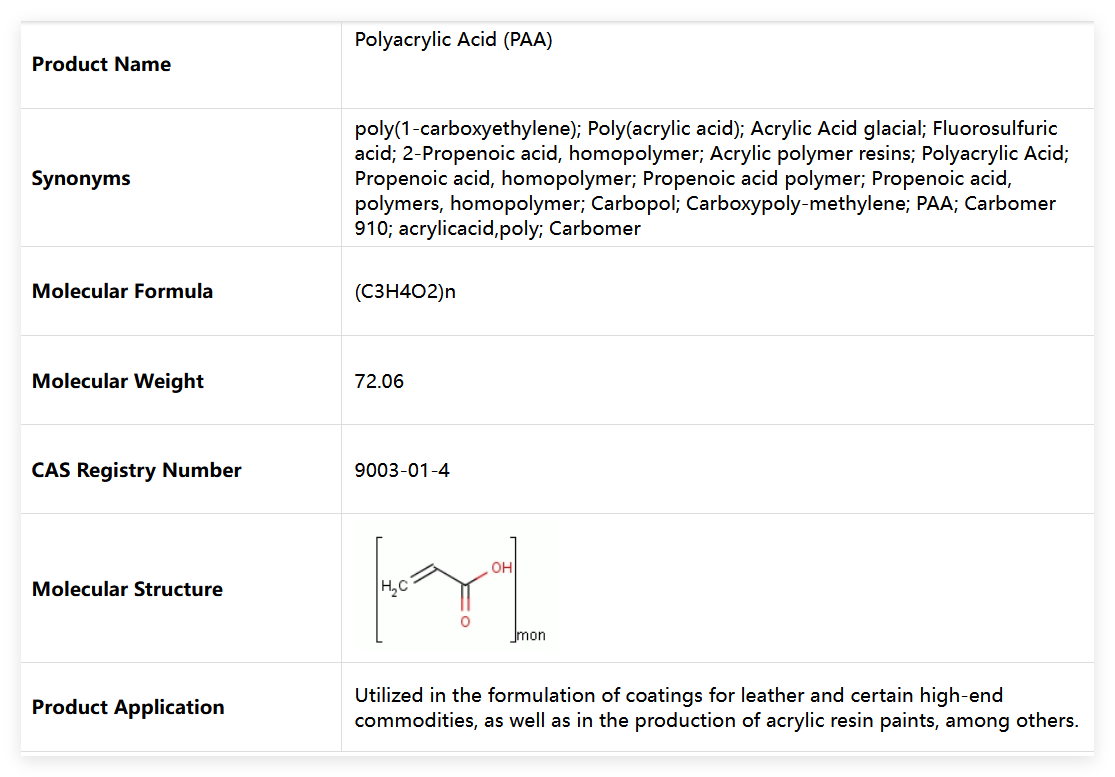
Are you struggling with scaling issues in cooling towers? Searching for reliable pharmaceutical excipients? Polyacrylic Acid (PAA) delivers proven solutions. This versatile polymer (CAS 9003-01-4) solves critical problems across multiple industries, from preventing costly equipment damage to enabling advanced biomedical innovations.
Our PAA is produced through controlled solution polymerization using acrolein oxidation-derived acrylic acid monomers. The process features:
Strict temperature control (50-150°C range)
Specialized initiator systems
Chain transfer agents like mercaptosuccinic acid
Polymerization inhibitors including hydroquinone
This ensures batch-to-batch consistency with molecular weight averaging 2000 - crucial for predictable performance in your applications.
PAA maintains stability where other polymers fail:
Withstands processing temperatures up to 116°C boiling point
Stable viscosity across environmental conditions
Flash point of 61.6°C enhances storage safety
As a procurement specialist, you'll appreciate how these properties reduce production downtime risks. One automotive coatings plant reduced material changeovers by 17% after switching to our consistent-grade PAA.
We guarantee:
99.5-99.9% purity with minimal impurities
Benzene residues controlled at 0.1-0.5%
Compliance with UN 3265 8/PG 3 transport regulations
These specs directly impact your bottom line. The high purity means you use less product per application - a textile factory reported 3.2% raw material savings after adopting our grade.
PAA simplifies your operations:
Instant water solubility eliminates pre-mixing steps
Standardized packaging with multilingual safety labels
Density of 1.09 (30% solution) enables accurate dosing
As one logistics manager noted: "Clear hazard labeling and leak-proof containers reduced our handling incidents by 22% last quarter."
PAA outperforms traditional scale inhibitors:
Extends heat exchanger cleaning cycles by 30-50%
Effective across water hardness levels (50-500 ppm CaCO₃)
Reduces biocide demand through superior particulate dispersion
A power plant using our PAA maintained condenser efficiency for 45 days versus their previous 30-day maximum - translating to $18,000/month in reduced maintenance costs.
In drug formulation, PAA enables:
Controlled-release matrixes via cyclodextrin cross-linking
Improved mucosal adhesion in transdermal patches
Stable dissolution profiles across pH ranges
One generics manufacturer achieved 23% faster dissolution consistency in accelerated stability testing using PAA-based binders.
While PAA requires standard chemical handling precautions, our approach ensures safety:
Full GHS-compliant SDS documentation
Bilingual (EN/CN) safety instructions
Minimal vapor pressure at room temperature
Proper handling makes irritation risks manageable - a chemical distributor reported zero handling incidents after implementing our recommended PPE protocol.
Our product meets:
REACH Annex XVII substance restrictions
FDA 21 CFR 175.300 for indirect food additives
EPA wastewater discharge guidelines
This compliance framework prevents costly regulatory surprises. European customers particularly appreciate our REACH documentation packages that simplify import processes.
A Midwestern chemical plant reported:
Scale reduction by 78% in cooling towers
Reduced blowdown frequency saving 1.2 million gallons annually
RO membrane life extension from 18 to 26 months
Their lead engineer stated: "The fast dissolution means we can respond quickly to changing water conditions without system shutdowns."
Researchers achieved:
4-hour sustained drug release in hydrogel matrices
30% improvement in wound adhesion strength
Consistent viscosity for 3D bioprinting applications
The lab director noted: "Batch consistency is paramount in FDA submissions - we've had zero variability-related rejections since switching suppliers."
When evaluating PAA suppliers, consider:
Concentration efficiency - our 30% solution reduces shipping weight
Dosing precision - consistent viscosity enables pump accuracy
Waste reduction - low-impurity grade minimizes filtration needs
One plant calculated 12% lower total cost despite higher unit price due to reduced processing steps.
Ensure your supplier:
Maintains dual-facility production capacity
Provides hazardous materials certified logistics
Offers technical support for application troubleshooting
Our customers value the 98.7% on-time delivery rate - particularly those in just-in-time manufacturing environments where delays cause costly line stoppages.
Selecting the right Polyacrylic Acid (CAS 9003-01-4) impacts more than specifications sheets - it affects operational efficiency, regulatory compliance, and ultimately profitability. With its unique combination of performance characteristics and handling advantages, PAA continues to prove its value across diverse industrial applications. When auditing your chemical procurement strategy, consider how high-purity, consistently manufactured PAA can solve multiple process challenges simultaneously while reducing total operational costs.