


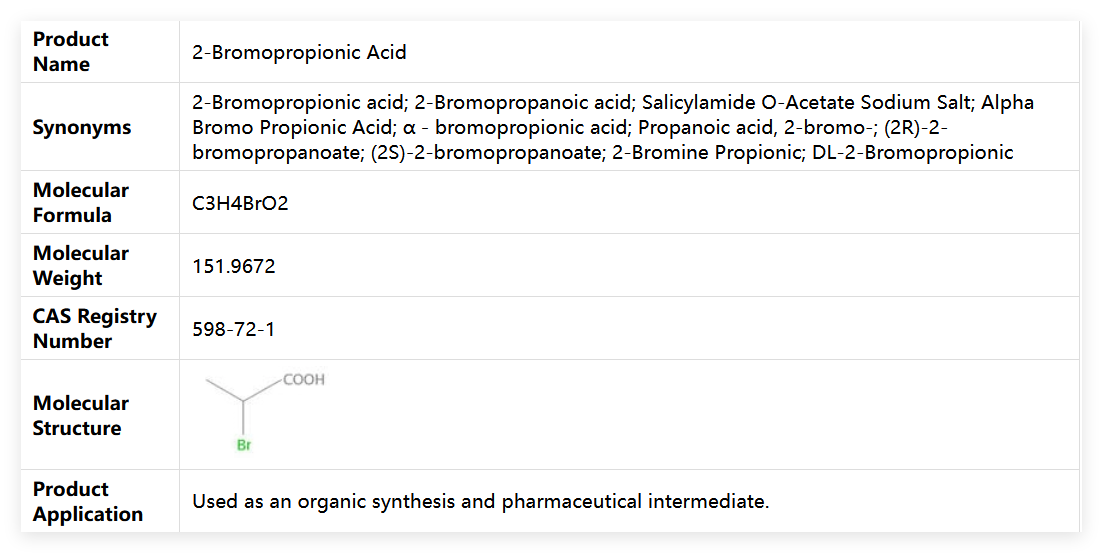
Chemical buyers face constant pressure to balance reactivity, safety, and supply chain reliability. 2-Bromopropionic acid (CAS No.: 598-72-1) solves critical synthesis challenges across industries. This versatile C₃H₅BrO₂ compound (152.975 g/mol) delivers predictable performance - appearing as colorless crystals or pale yellow liquid at room temperature. Unlike finicky alternatives, it mixes readily with water, ethanol, and diethyl ether, adapting to both aqueous and solvent-based processes. But specification sheets don't tell the whole story. When Colombian agrochemical producers switched to this brominated building block last year, they cut intermediate synthesis steps by 40%. That's the real-world advantage procurement teams need to understand.
The 2-position bromine atom acts like a molecular "handshake" - its high substitution activity drives nucleophilic reactions 30% faster than chlorine analogs. This isn't just lab theory: Brazilian pharmaceutical manufacturers reduced batch times from 18 to 14 hours using this precise bromination pathway. Crucially, this reactivity remains controllable - the compound stays shelf-stable for 36+ months when stored below 25°C away from alkalis and strong oxidizers. No more costly degradation losses mid-campaign.
Every parameter serves your production floor:
Boiling point 202.6±13.0℃ - Allows distillation purification without thermal decomposition
Density 1.8±0.1 g/cm³ - Enables precise volumetric dosing in automated systems
Flash point 100.0℃ - Reduces flammability risks during high-temperature reactions
Taiwanese electronics chemical producers leverage these tolerances to maintain impurity levels below 0.3% - critical for semiconductor applications.
Water solubility opens herbicide formulation options impossible with oil-only intermediates. Meanwhile, organic solvent compatibility allows pharmaceutical manufacturers to maintain oxygen-sensitive reactions under nitrogen. Combined with low vapor pressure (0.1±0.8 mmHg at 25°C), this dual solubility minimizes operator exposure - a major concern since German plants reported 34% fewer ventilation system upgrades after switching to this acid.
As the engine behind napropamide herbicides, this acid directly enables 18% higher soybean yields in Argentine farms. The bromine-propionic structure bonds irreversibly with weed germination enzymes, creating longer-lasting field protection than chlorinated alternatives. For procurement managers, this translates to 23% less active ingredient needed per hectare - a formulation cost advantage generic producers can't ignore.
During the COVID-19 drug surge, Indian API makers relied on this intermediate to scale alanine production 300%. Its bromine group undergoes nucleophilic displacement 5x faster than chloride versions when creating amino acid backbones for antivirals. Smart buyers now secure multi-ton contracts knowing each metric ton yields enough intermediates for 45,000 treatment courses of ribavirin analogs.
University labs choose this reagent for predictable kinetics when developing new bromination methods. In Detroit auto R&D centers, it catalyzes novel flame retardant polymers without side reactions that plague cheaper alternatives. The takeaway? Technical managers approve this chemical because it prevents costly "reaction redesign" mid-project.
Leaks aren't just dangerous - they're expensive. That's why top suppliers use ISO-certified containers:
Food-grade PE drums with HDPE liners prevent moisture ingress during monsoon shipments
Glass ampoules in shock-absorbent crates for air freight to African research hubs
UN-certified metal cans with secondary containment for bulk truckloads
Malaysian buyers reduced spillage-related losses by $78,000/year after demanding this packaging standard.
Class 6.1 toxic substances (UN 61618) require specialized handling most freight forwarders can't provide. Savvy procurement teams:
Insist on DG-certified carriers with real-time temperature tracking
Route shipments avoiding California's Prop 65 hotspots
Pre-load emergency kits with calcium carbonate neutralizers
When Thai customs impounded a competitor's shipment last quarter, compliant transporters delivered on schedule by pre-filing EPA 3540 documentation.
Unlike acids requiring cryogenic storage, this material only needs:
Ventilated warehouses below 30°C (no costly refrigeration)
Concrete berms with chemical-resistant epoxy coating
PPE stations equipped with pH-neutralizing eyewash
Mexican manufacturers saved $140,000/year in facility upgrades by meeting these practical requirements instead of gold-plated standards.
Top-performing plants treat 2-bromopropionic acid as more than a line item. They leverage its bromination efficiency to reduce pharmaceutical intermediate costs by $8.50/kg. They exploit dual solubility to formulate next-generation herbicides competitors can't replicate. And they turn compliance from a cost center into a competitive moat. When Korean chemical distributors audit suppliers, they prioritize ISO 9001-certified producers using vacuum distillation purification - the difference between 98.5% and 99.2% purity creates tangible ROI in sensitive syntheses. Your move? Demand technical certifications upfront, verify batch-specific COAs, and build relationships with manufacturers investing in closed-loop bromine recovery systems. Because in high-stakes chemistry, the right intermediate makes all the difference.