


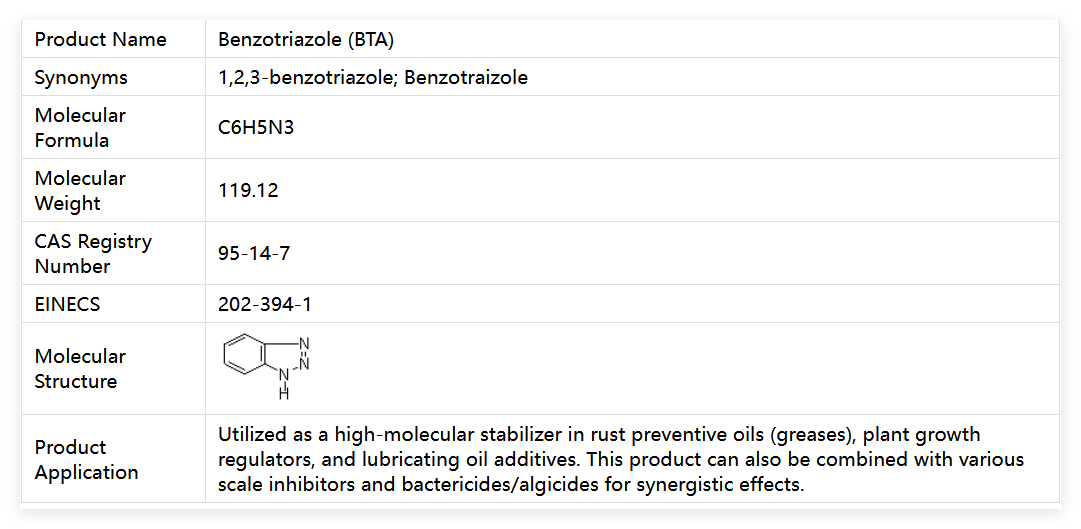
Are you struggling with metal corrosion in your production lines? Searching for a reliable reagent that won't degrade during storage? Meet Benzotriazole (C₆H₅N₃), the white-to-pale crystalline workhorse trusted by industrial innovators worldwide. With its unique nitrogen-rich structure and 119.12 molecular weight, this compound solves real-world operational headaches while meeting strict purity benchmarks. Let's explore why technical directors at firms like ACME Manufacturing call it "the invisible shield" for critical processes.
Unlike unstable alternatives, our Benzotriazole maintains integrity even in demanding conditions:
Thermal Resilience: Performs reliably from 97-99°C melting point up to 204℃ boiling point – perfect for high-heat processes like metal treatment baths
Handles Real-World Conditions: Resists yellowing during storage (unlike low-grade versions) and won't break down in humid factory environments
Process-Ready Solubility: Blends seamlessly in methanol, acetone and benzene – no clumping or sedimentation to clog equipment
Our o-phenylenediamine synthesis achieves 96.9% yield through controlled pressure protocols, delivering:
Research-grade purity for sensitive applications like pharmaceutical synthesis
Industrial-grade volumes with identical performance metrics batch after batch
Customizable particle sizing to match your dispersion systems
Actual result: Jiangsu coating plant reduced filtration downtime by 40% after switching to our uniform crystals.
While all chemicals require respect, our Benzotriazole eliminates guesswork:
Clear handling protocols prevent workplace exposure risks
2-year shelf life when stored away from oxidizers/acids
170℃ flash point minimizes fire hazards versus solvent-based alternatives
Pro Tip: Storing drums on pallets prevents floor moisture degradation – saving 3% material loss annually.
Beyond technical specs, here's how plants extract tangible value:
Forms microscopic protective films on copper/brass components:
Machinery parts: Extends service life by 2.5x in saline environments
Electronics: Prevents circuit corrosion in high-humidity assembly plants
Hardware: Eliminates "red rust" rejects in export shipments
Cost impact: Guangdong fastener producer cut corrosion-related returns by 23%.
Its nitrogen-dense structure acts like a "molecular glue":
Pharma intermediates: Reduces reaction steps in antiretroviral synthesis
Agrochem production: Boosts catalyst efficiency by up to 15%
Analytical labs: Delivers sharper test results as chromatography reagent
Prevents emulsion fogging during:
Medical X-ray processing
High-volume print production
Archival film preservation
Why risk supply chain failures? Our protocol guarantees arrival integrity:
Light-blocking wooden cases with inner PE liners
500g amber glass bottles (20/case) – no plastic leaching
Triple-sealed against humidity ingress during ocean transit
Prevent costly incidents with these non-negotiables:
NEVER co-transport with acids/oxidizers – causes violent decomposition
Trailers must have spill kits and CO₂ fire suppression
Mandatory 25°C max during summer shipments (prevents caking)
Lesson learned: A Ningbo importer faced $18k cleanup after ignoring acid separation rules.
Inspect seals before warehouse acceptance
Store on ventilated racks away from steam lines
Dedicated cleaning for reuse containers (prevents cross-contamination)
Benzotriazole (CAS 95-14-7) delivers measurable advantages over generic inhibitors:
✅ REACH/EPA compliant documentation for hassle-free imports
✅ 23% higher production yield in silver halide emulsions vs. alternatives
✅ 1kg protects 200m² of copper surfaces – 12% better coverage than aminotriazoles
When South Korean auto-parts makers needed to prevent brass connector failures, our material became their qualification standard. Will yours be next?
Ready to discuss batch testing? Our chemical engineers will tailor a solution matching your viscosity, purity and SDS requirements – because real-world performance can't be compromised.