
water treatment chemicals, Pesticides and Other Chemicals
Home / Products / Water Treatment Chemicals / Tolyltriazole (TTA) CAS 136-85-6 29385-43-1

loading

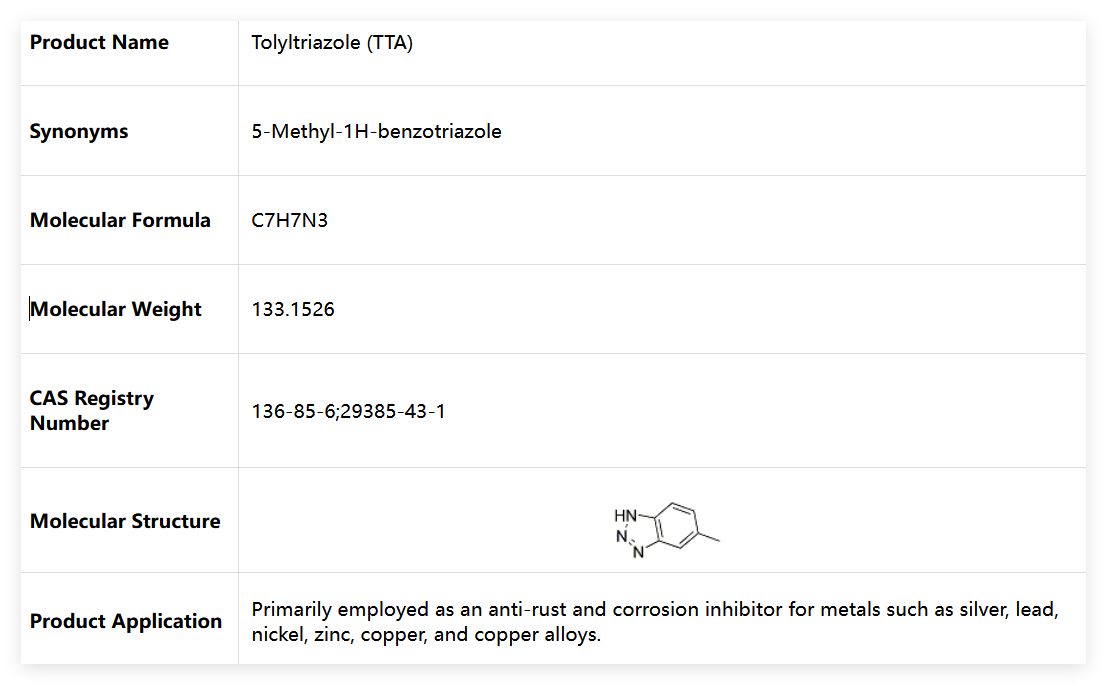
Tolyltriazole (TTA) CAS 136-85-6 29385-43-1

Tolyltriazole (TTA) has corrosion inhibition effect on copper and copper alloy. It can be compounded with other organic corrosion inhibitors or added separately. Methylbenzotriazole is used at a concentration of 2 to 10 mg/L.
CAS: 136-85-6/29385-43-1
Availability:
facebook sharing button
twitter sharing button
line sharing button
wechat sharing button
linkedin sharing button
pinterest sharing button
whatsapp sharing button
sharethis sharing button

32

Core Product Description

5-Methylbenzotriazole, referred to as the core component of TTA, is a type of nitrogen-containing heterocyclic compound with high-efficiency metal protection performance. Its chemical formula is C₇H₇N₃, molecular weight is 133.151, CAS number is 136-85-6, and EC number is 205-265-8. In industrial fields, it is often used under names such as "tolyltriazole" and "5-methyl-1H-benzotriazole". The product appears as white to pale yellow needle-like powder (some batches may present as light brown powder due to purity differences), and its aqueous solution is weakly acidic (pH 5.5-6.5). It combines chemical stability and targeted protection functions, serving as an important upgraded product among benzotriazole (BTA)-type corrosion inhibitors, and is widely suitable for metal protection needs under various harsh working conditions.

Core Product Features

Stable and Controllable Physicochemical Properties

The product has a stable melting point of 80-82 °C (literature-verified value), a boiling point of 360.6±11.0 °C (under 760 mmHg), and a flash point of 181.5±12.2 °C, exhibiting excellent high-temperature stability and tolerance to conventional heating scenarios in industrial production. Its density is 1.3±0.1 g/cm³, and its vapor pressure is extremely low (only 0.0±0.8 mmHg at 25 °C), resulting in no significant volatilization loss during use. Meanwhile, it is easily soluble in organic solvents such as methanol, acetone, and cyclohexane, but poorly soluble in water (solubility of 6.0 g/L at 25 °C) and petroleum-based solvents, facilitating the adjustment of dissolution systems according to working conditions.

Strong Molecular Structure Compatibility

The molecule contains 1 hydrogen bond donor and 2 hydrogen bond acceptors, with no rotatable chemical bonds and 3 tautomers. Its topological polar surface area (TPSA) is 41.6. This structure enables it to form stable complexes with metal ions. Additionally, it has good tolerance to both acidic and alkaline environments and can form stable metal salts with alkali metal ions, making it compatible with industrial systems of different pH values.

Outstanding Protective Film Characteristics

The protective film formed when reacting with metals is only 5×10⁻⁷ cm thick. The extremely thin film does not affect the precision of metal components or subsequent processing, while maintaining strong stability in various media such as water and acidic solutions, effectively blocking corrosion factors from contacting the metal surface for a long time.

Outstanding Product Advantages

Wider Compatibility for Corrosion Inhibition in Different Scenarios

Compared with traditional benzotriazole (BTA), its core advantage lies in **better corrosion inhibition performance in low-pH acidic media**—BTA only performs well in the pH range of 5.5-10, while this product can still efficiently combine with cuprous ions in acidic working conditions to form an inert complex protective film. It fills the gap in the protection of copper and copper alloys in acidic environments, and is particularly suitable for industries such as electronics and electroplating that often involve acidic cleaning processes.  

Balance of Cost-Effectiveness and Practicality

When used as a corrosion inhibitor for copper and copper alloys, it can be used alone or mixed with 4-methylbenzotriazole (CAS: 29878-31-7) to form the commercial product "TTA". No additional process adjustments are required when mixed, and the protection effect can be further improved. Moreover, it requires a small dosage and takes effect quickly, reducing the unit protection cost while minimizing equipment maintenance and replacement costs caused by metal corrosion.

Balance of Chemical Stability and Safety

Although it has a certain degree of irritation, its acute toxicity is relatively low (oral LD₅₀ in rats is 1600 mg/kg), and there is no evidence that it contains carcinogenic components (IARC assessment shows no components ≥0.1% are carcinogenic). When used with standardized protective measures, it can ensure production safety while avoiding significant risks to the health of operators.

Diverse Product Applications

Corrosion Inhibition and Protection for Copper and Copper Alloys (Main Application)

- Electronics Industry: Used for process protection of copper components such as printed circuit boards (PCBs) and chip pins, preventing corrosion of copper layers by acidic etchants and cleaning solutions, and ensuring the electrical conductivity and service life of circuits.  
  - Refrigeration Industry: Added to the circulation system of copper refrigeration condenser tubes in air conditioners and refrigerators to inhibit corrosion of pipes by water quality and refrigerants, reducing leakage risks.  
- Automotive Industry: Used for rust prevention of copper alloy pipelines in engines and copper components of radiators, adapting to the high-temperature environment of engines and the acidic nature of cooling fluids.

Specialized Rust Prevention for Copper Materials

Directly used for rust prevention during the storage and transportation of copper materials. A protective film can be formed on the copper surface through spraying or dipping, preventing oxidative discoloration and rust caused by environmental humidity and oxygen during storage.

Intermediate for Organic Synthesis

As a nitrogen-containing heterocyclic framework, it is used in the synthesis of functional molecules in the pharmaceutical and pesticide fields, or in the preparation of other high-performance corrosion inhibitors, stabilizers, and other fine chemical products.

Detailed Product Specifications and Storage

Mainstream Product Specifications (Common Market Brands)

| Brand                  | Specification | Purity     | Market Price | Member Price | Applicable Scenarios               |
|------------------------|---------------|------------|--------------|--------------|------------------------------------|
| Gubiao/Tanmo Quality Inspection | 100mg        | ≥98.0%     | ¥120.00     | ¥78.00      | Laboratory R&D, small-dose testing |
| Dibo                   | 5g           | 0.98 (98%) | ¥26.00      | ¥16.00      | Pilot production, small-scale industrial applications |
| Yuanye                 | 5g           | 98%        | ¥30.00      | ¥26.00      | Industrial mass production, conventional protection |

Storage Requirements

- Storage Environment: Should be placed in a cool, dry, and well-ventilated area. Refrigerator-grade storage conditions are recommended (avoid high temperature and humidity).  
- Packaging Requirements: Keep the container sealed to prevent powder from absorbing moisture and caking or contacting air for a long time.  
- Isolation Requirements: Keep away from incompatible substances such as strong oxidizing agents and strong acids to avoid chemical reactions affecting product performance.

Previous: 
Next: 
JIANGYIN TRUST INTERNATIONAL INC was established in 1996, dedicated to the production and export of water treatment chemicals, intermediates, and other chemicals. 

QUICK LINKS

PRODUCT CATEGORY

CONTACT US

 Room 807,No.169 Changjiang road,Huifu plaza,New centre,Jiangyin,Jiangsu China
 +86-13961672821
 +86-510-86268020
Copyright © 2023 JIANGYIN TRUST INTERNATIONAL INC Technology By leadong.com | Sitemap