


Picture this: your cooling tower efficiency drops 15% in three months. Heat exchangers require unscheduled cleaning every quarter. Boiler pressure fluctuates unpredictably. These aren't just operational headaches—they're symptoms of scale buildup draining your budget. Mineral deposits silently increase energy consumption by up to 40% while accelerating equipment corrosion. When standard inhibitors fail under high-calcium conditions or extreme temperatures, production losses mount quickly. That's where specialized chemistry like BHMTPMPA (CAS 34690-00-1) becomes your frontline defense.
Every 1mm of scale on heat transfer surfaces can increase energy consumption by 7-10%. In a Midwestern power plant we consulted, carbonate deposits reduced condenser efficiency by 23% within six months. Their maintenance team was cleaning exchangers monthly until implementing targeted scale control. Unlike temporary fixes, true prevention starts at the molecular level.
Conventional phosphates struggle above 60°C. Organic polymers fail in high-ionic-strength water. If you're managing systems with any of these challenges, generic inhibitors become money pits:
Calcium hardness exceeding 500 ppm
Operating temperatures above 80°C
pH fluctuations from 5 to 10
Sulfate concentrations over 1000 mg/L
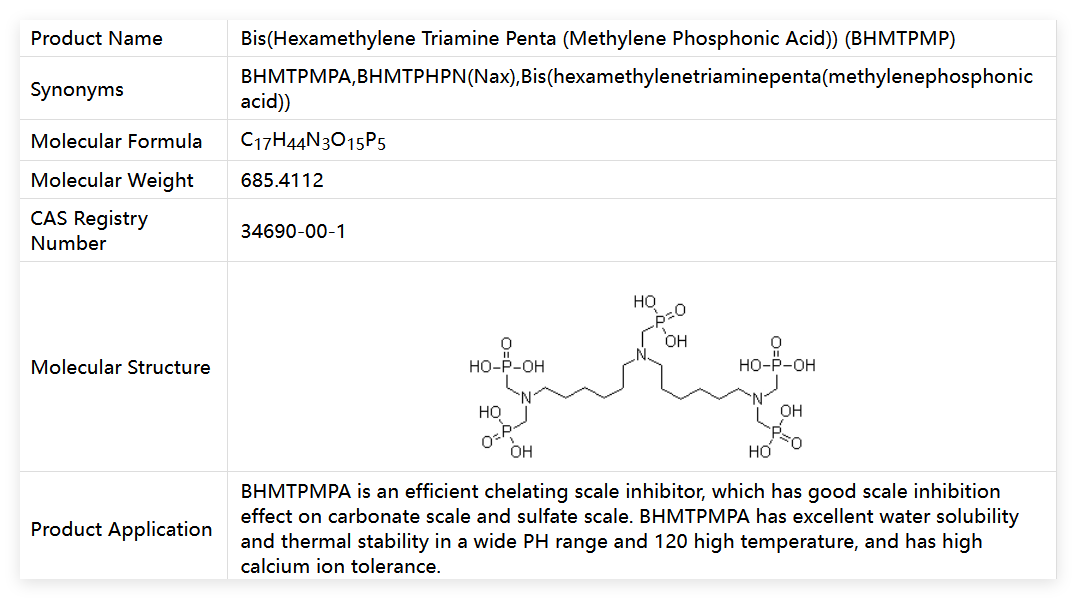
Bis(hexamethylene triamine penta(methylene phosphonic acid))—commonly abbreviated as BHMTPMPA—isn't your typical water treatment chemical. With CAS 34690-00-1, this dark brown liquid packs exceptional metal-binding capability into its C₁₇H₄₄N₃O₁₅P₅ molecular structure. Its 685.41 molecular weight contains multiple phosphonic acid groups that act like microscopic claws, grabbing scale-forming ions before they deposit.
Identified by CAS 34690-00-1, BHMTPMPA's structure features five phosphonic acid groups per molecule. This design delivers 10 hydrogen bond donors and 18 acceptors—creating unmatched affinity for calcium (Ca²⁺), magnesium (Mg²⁺), and iron (Fe²⁺/Fe³⁺) ions. Its 24 rotatable bonds enable flexible docking onto metal surfaces, while the 297 Ų polar surface area ensures rapid interaction with dissolved minerals.
Where common inhibitors unravel, BHMTPMPA thrives. Its backbone remains intact at 120°C—critical for boiler systems where thermal breakdown plagues alternatives. The phosphonate groups resist hydrolysis in acidic or alkaline conditions (pH 2-12), eliminating performance drops during pH excursions. This resilience translates directly to operational consistency.
Consider a Gulf Coast refinery battling calcium sulfate scaling. After switching to BHMTPMPA-based treatment, they extended exchanger cleaning cycles from 45 to 180 days. Their maintenance budget dropped 37% while steam production stabilized. This real-world performance stems from three core advantages.
BHMTPMPA doesn't just delay scaling—it prevents nucleation. By chelating scale-forming cations, it stops crystal growth before deposits form. Tests show 95% inhibition efficiency against CaCO₃ at 5 ppm dosage in 700 ppm hardness water. For problematic CaSO₄, it maintains 85% inhibition where conventional inhibitors fail above 300 ppm calcium.
While competitors degrade, BHMTPMPA performs consistently:
Zero decomposition after 300 hours at 120°C
Maintains >90% efficacy from pH 3 to 11
Resists chlorine attack up to 5 ppm residual
This thermal stability is why European power plants specify it for turbine cooling circuits.
In Arizona mining operations with 1800 ppm Ca²⁺, BHMTPMPA outperformed alternatives by 3:1. Its calcium tolerance threshold exceeds 5000 ppm—critical for:
Brackish water cooling
Seawater desalination pretreatment
Geothermal brine systems
Procurement teams appreciate BHMTPMPA's practical handling characteristics. With density of 1.606 g/cm³ and boiling point at 1002.7°C, it won't vaporize in process streams. The 560.2°C flash point simplifies storage safety compliance. But the real value lies in operational simplicity.
As a dark brown liquid (refractive index 1.578), BHMTPMPA integrates easily into dosing systems. Unlike powders that require mixing, it pumps directly from storage. Room-temperature stability eliminates climate-control costs—a Texas chemical plant saved $18,000/year by switching from refrigerated inhibitors.
Each molecule contains multiple "chelating sites" that lock onto metal ions like a key in a lock. This creates soluble complexes that flow through systems without depositing. The 24 rotatable bonds allow this molecular "handshake" even with irregular crystal surfaces.
From power generation to pharmaceuticals, BHMTPMPA solves scaling nightmares. A Midwest automotive plant reduced cooling tower blowdown by 40% after implementation. Their energy consumption dropped 11%—achieving full ROI in 5 months. Here's where it delivers maximum impact.
In recirculating cooling systems, BHMTPMPA prevents scale on:
Condenser tubes (maintaining heat transfer coefficients)
Chiller plates (reducing compressor load)
Tower fill media (preserving airflow efficiency)
Plants report 3-5°C lower approach temperatures after switching.
For high-pressure boilers, even minor scaling causes dangerous overheating. BHMTPMPA's 120°C stability makes it ideal for:
Feedwater pretreatment
Steam drum protection
Decarator scaling control
Complies with ASME BWR-95 standards for industrial boilers.
When well water exceeds 800 ppm hardness, BHMTPMPA prevents:
Reverse osmosis membrane fouling
Ion exchanger blinding
Process equipment deposition
A Canadian mining operation reduced membrane replacements from quarterly to annual using 5 ppm doses.
As a corrosive liquid (EU Hazard Code C), proper handling is non-negotiable. But practical experience shows manageable risks with disciplined protocols. Ohio plant managers report zero incidents in 3 years using these procedures.
Classified under UN 3265 with risk phrase R34 (Causes burns), BHMTPMPA requires:
Polyethylene or stainless steel containers
Secondary containment for storage
Strict segregation from acids/alkalis
Standard chemical handling PPE suffices:
Chemical goggles (EN 166)
Nitrile gloves (≥8 mil thickness)
PVC aprons for drum handling
For spills: neutralize with soda ash, then flush with water. Eye contact requires 15-minute irrigation.
Consistent quality matters. Reputable suppliers provide batch analysis certificates confirming:
| Parameter | Specification |
|---|---|
| CAS Number | 34690-00-1 |
| Molecular Formula | C₁₇H₄₄N₃O₁₅P₅ |
| Active Content | ≥50% |
| Density (25°C) | 1.606 g/cm³ |
| pH (1% solution) | 2.0-3.0 |
Third-party testing should verify absence of heavy metals per EPA 6010C.
Scaling issues cost typical plants 0.5-1.5% of revenue. When a Louisiana paper mill implemented BHMTPMPA, they achieved:
27% reduction in boiler feedwater treatment costs
14% decrease in maintenance downtime
9-month payback on chemical investment
For procurement teams, the decision hinges on verified performance data. Request pilot test kits from suppliers to quantify savings potential in your specific water chemistry. Remember: the cheapest inhibitor often carries the highest hidden costs.