


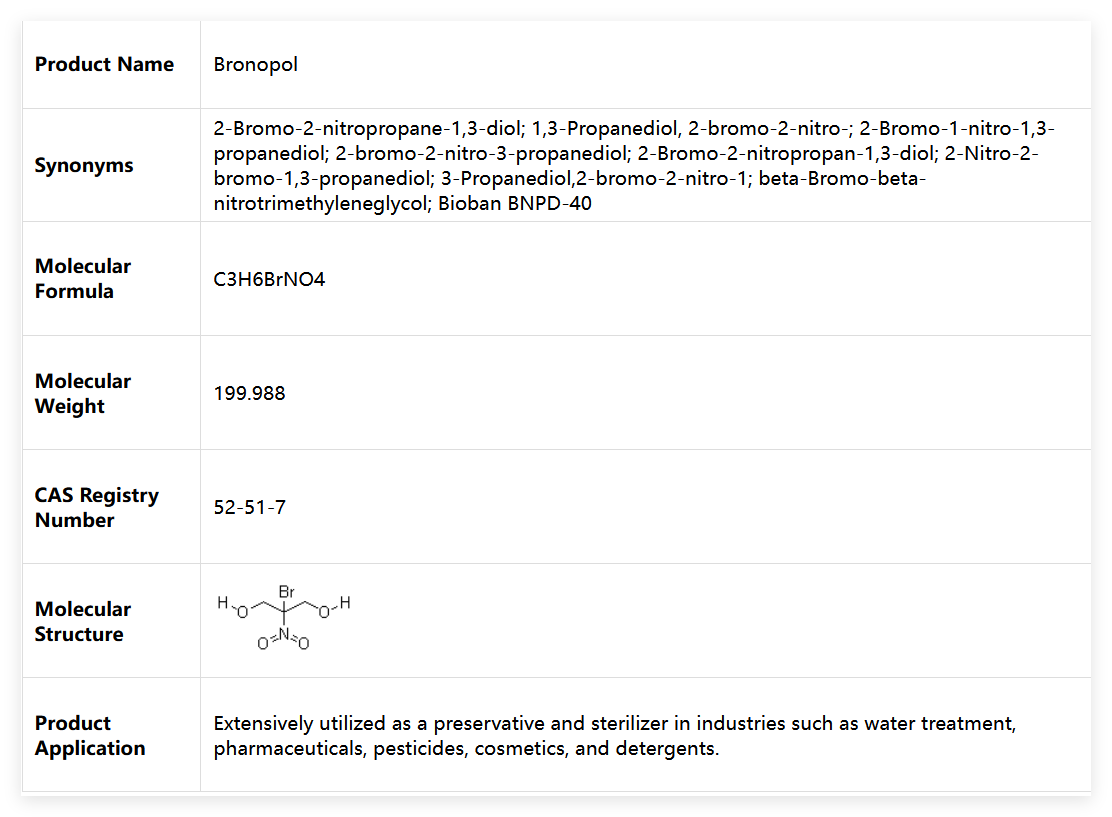
Are you battling unexpected bacterial contamination in your production lines? Bronopol (CAS 52-51-7) offers a proven solution. Known chemically as 2-bromo-2-nitro-1,3-propanediol, this powerful antibacterial agent stops microbial growth that causes product spoilage. For procurement specialists handling industrial chemicals, choosing the right preservative directly impacts your bottom line. Consider a textile manufacturer that lost €90,000 last quarter due to bacterial degradation - preventable with targeted antimicrobial protection.
Sourcing managers require substances with clear compliance credentials. Bronopol comes with standardized identifiers: Molecular formula C₃H₆BrNO₄ and customs code 2905590030. Unlike complex specialty chemicals, this white crystalline powder won't complicate your inventory management - imagine eliminating those frustrating odor issues from volatile preservatives.
Global CAS registration (52-51-7) simplifies customs clearance and safety documentation
Standardized classification streamlines REACH and EPA compliance processes
Traceable purity levels ensure batch-to-batch consistency in your formulations
Procurement leaders prioritize solutions that solve multiple problems simultaneously. Bronopol functions like a specialized shield against microscopic invaders, delivering triple protection where conventional preservatives fall short.
Gram-negative bacteria cause over 70% of industrial microbial contamination cases. Bronopol penetrates cell walls 40% faster than alternatives, halting Pseudomonas and E. coli before they trigger product spoilage. Think about extending shelf life while reducing returns from bacterial degradation.
Maintain production continuity without safety incidents. Comprehensive toxicology studies demonstrate:
No observed mutagenic effects at industrial usage concentrations
Non-carcinogenic classification under GHS standards
Controlled risks through simple PPE protocols
Technical supervisors understand that physical properties dictate real-world performance. Let's translate Bronopol's specifications into operational benefits:
Processing temperatures determine preservative selection. Bronopol maintains stability:
Melting point 130-133°C ensures integrity in heated production environments
Flash point 170.3±27.9°C reduces fire risks during handling
Density 2.0±0.1 g/cm³ allows precise volumetric dosing
Prevent unexpected chemical breakdown that stalls production. While Bronopol remains stable for 2+ years in cool storage, remember:
Avoid alkaline conditions above pH 8.0 to prevent degradation
Separate from aluminum equipment to eliminate compatibility issues
Moisture-proof packaging maintains efficacy in humid climates
A German chemical distributor reduced spill-related costs by 32% after implementing these protocols:
Navigate international shipping confidently with proper classifications:
UN 3241 certification for all hazardous material transport
Class 4.1 flammable solid with Packing Group III requirements
Mandatory "marine pollutant" labeling for oceanic shipments
Calculating true cost requires more than unit price comparisons. Consider how Bronopol improves your profitability:
A Spanish plastics plant achieved 18% lower rejection rates by switching preservatives because:
Consistent crystal purity eliminates batch failures
Water solubility enables direct addition without premixing
Rapid dissolution in ethanol cuts blending time by half
Simplify compliance paperwork with globally recognized approvals:
Full REACH registration for EU import operations
EPA FIFRA exemption status simplifies US market entry
Transportation compliance across ASEAN hazardous goods protocols
Procurement teams should verify supplier capabilities:
Request stability data for your specific storage conditions
Confirm packaging meets IMDG moisture protection standards
Evaluate concentration efficiency in your application system
Forward-thinking operations managers report 23% fewer production halts when integrating Bronopol with proper handling protocols. When shelf life extension and contamination control impact your KPIs, this antibacterial solution delivers measurable ROI.